
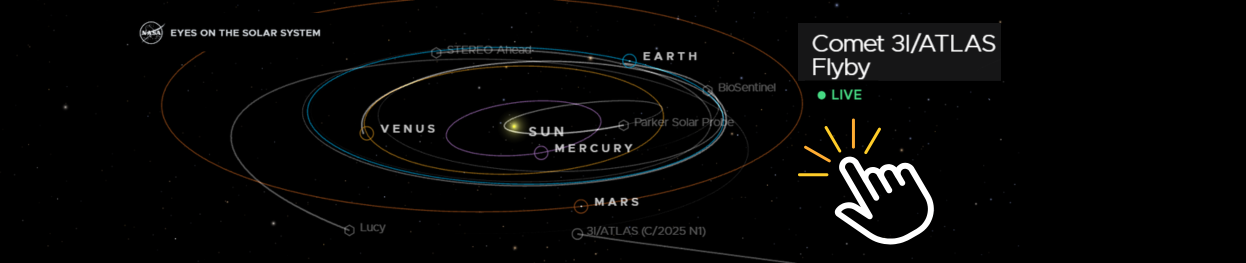
When 3I/ATLAS will be most observable from Earth?
Short answer: early December 2025, just after it reappears from behind the Sun, is when 3I/ATLAS will be most observable from Earth—though it’ll still be faint (≈ magnitude 12–13) and require a medium/large telescope.
Why:
It reaches perihelion around Oct 29–30, 2025, but is in solar conjunction (too close to the Sun in our sky), so it’s essentially unobservable from Earth around late Oct–early Nov. (NASA Science)
It becomes visible again before sunrise in November 2025 and is expected to be faint throughout. Its closest approach to Earth is ~Dec 19, 2025 (~1.8 AU), so practical peak observing for amateurs is early–mid December 2025 (pre-dawn window), when elongation improves a bit. (NASA Science)
 Visibility Timeline
• Late October 2025 → Not observable. ATLAS passes perihelion (Oct 29–30) while too close to the Sun’s glare (solar conjunction).
• Mid–late November 2025 → Begins to emerge in the morning sky, low before sunrise. Still faint, magnitude ~13.
• Early–mid December 2025 → Best observing window for Northern Hemisphere observers. It will be highest above the horizon before dawn, with magnitude ~12–13. Plan on at least ~200 mm (8-inch) aperture to visually detect a diffuse mag-12–13 comet. (It is not expected to be naked-eye or binocular-bright.)
• Late December 2025 onward → Fades slowly as it recedes; by January 2026 it will be dimmer, requiring large telescopes.
Southern Hemisphere observers,
Pre-dawn sky in late Nov–Dec 2025.
Plan on at least ~200 mm (8-inch) aperture to visually detect a diffuse mag-12–13 comet. (It is not expected to be naked-eye or binocular-bright.)